We are moving our blog to our new website
www.fallowdeerreserve.org
Check it out!
Friday, May 20, 2011


Saturday, April 23, 2011
Antlers, for sale
We have three sets of antlers that have not been spoken for yet this year. Prices range from $85 to $100 for a matching pair of naturally shed antlers along with a photo of the buck wearing the antlers. It's a great way to support the Reserve. Lengths vary from 24-29 inches and palm average about 5 inches.

For more information, please email us at
jmcd@reztel.net
Thanks.

For more information, please email us at
jmcd@reztel.net
Thanks.
Friday, April 22, 2011
Antler Sweepstakes 2011
Antlers started falling on April 8 this year about three days later than last. Here is the order. There is some thinking that the most dominant buck loses his antlers first
2011
1.Moki, April 8
2.Bash, April 8, 9
3.Mike, April 13
4.Buddy, April 14, 15
5.EGee, April 16
6.Spike, April 16
7. Max, April 16
8. Murph, April 21, 22
2010
1. Moki, April 6
2. Bash, April 6
3. Murph, April 8
4. Buddy, April 12
5. Mike, April 15
6. Spike, April 15
7. Max, April 15, April 16
8. EGee, April 18
2011
1.Moki, April 8
2.Bash, April 8, 9
3.Mike, April 13
4.Buddy, April 14, 15
5.EGee, April 16
6.Spike, April 16
7. Max, April 16
8. Murph, April 21, 22
2010
1. Moki, April 6
2. Bash, April 6
3. Murph, April 8
4. Buddy, April 12
5. Mike, April 15
6. Spike, April 15
7. Max, April 15, April 16
8. EGee, April 18
Sunday, April 10, 2011
New feeding stations


This winter we developed a system using the large bowls that came with the AP-18 mineral licks rather than just putting the grains on the ground and hoping each one received adequate nutrition or meds. By quickly pouring the grains into the bowls, all the bucks were able to consume equal amounts. Don Murphy designed some simple troughs that allow for quick pouring of the 600g portion. As this feeding has been a daily occurrence, the bucks soon got used to it. Only the same number of bowls as deer to be fed are filled, so they tend to stay put rather than waste time moving from bowl to bowl.
Problems with the bowls on the ground occurred when the bucks knocked the buckets about so that we could not reach the bowls from the outside of the fence or, as does happen, someone pooped in a bowl. Snow, ice and rain also caused some difficulties. Sometimes, antlers got hooked into the fence if the bowl was too close to it. This system with the bowl on a slant keeps the grains as far away from the fence as possible and the bowls are big enough to allow space for brow antlers.
We tried the prototype yesterday using EGee as our test buck. He paced back and forth a few times sniffing the air and trying to figure out this new contraption. After about 30 seconds, he had no trouble digging in as these photos show.
Thanks to our godchild, Miesje Stewart and her cousin Logan Stewart, we have put together six feeding stations and should have all eight at the Reserve by tomorrow.
Monday, April 04, 2011
Update: EGee

EGee, April 2, 2011
EGee continues to remain skinny but otherwise okay (eating, pooping, pronking, etc). He is still in isolation and receiving daily grains with added probiotics in addition to hay.We are waiting for the antlers to fall before we release him back with the others in the herd. Last year the first antlers fell on April 5, so soon he will be back with his buddies. We are just too worried that he will lose any fight as he weighs significantly less than the other 7. Or, he may think he is the king of the castle having not had to jostle or fight for position in the herd for the past two months. So that’s the reason for the delay in introducing him back to the herd.
At the very least, we no longer worry that we will find him dead, and we dare to think he is going to make it for awhile longer. Thank goodness for warmer weather.
Sunday, March 27, 2011
Insight from the Dalai Lama
The creatures that inhabit this earth -- be they human beings or animals -- are here to contribute, each in its own particular way, to the beauty and prosperity of the world.
Saturday, March 19, 2011
Annual General Meeting Minutes
Minutes of the fourth Annual General Meeting held on Wednesday, March 16, 2011 in Kingston, Ontario
Present: Don Murphy, President, Jane McDonald, Treasurer, Allan Park, Head Deer Keeper, Wendy Workman, Secretary, Lorraine Alderman, Aida Sulcs, Annie Wilcox, Board Members
The meeting was called to order at 5:30pm. The Agenda for this meeting was approved as well as the minutes of the 2010 Annual General Meeting held in February 2010.
The President welcomed all present and gave a brief summary of the activities of this challenging year in which we lost two deer, Gulliver (August 2010) and George (February 2011). We have learned a great deal from these losses. With help from volunteers, we completed the isolation paddock (approx 3/4 acre) in the Fall and put it to good use with the rehabilitative care of E Gee who continues to require special care due to his underweight status. He especially thanked Allan Park for his dedication and compassionate care of the herd and recognized the contribution of Jane McDonald, too. He made several suggestions for future planning detailed below.
Copies of the financial statements for the period January 1, 2010 to December 31, 2010 were distributed to those present by the Treasurer, reviewed and accepted. Generally income and expenses were half of those in 2009 showing that some fundraising efforts need to be made in 2011 in order to meet the increasing costs caused by the aging of the deer (increased nutrition, more shelter from cold, higher vet bills).
The Head Deer Keeper, Allan Park, thanked the board members and noted the contributions of Jane McDonald, Don Murphy, Wendy Workman throughout the year as well as volunteers, Susie Rance, Chris Grooms, Paul Nixon and Drew Sauve in the creation of the isolation paddock and Emerald Murphy for hay and equipment, Bob and Norma for donating hay. He also noted the loss of our oldest volunteer, 93 year old Bruce Burt, who died in May 2010. He was a regular visitor and donated over 130 bales of hay each year. He recounted the circumstances of and lessons learned from the deaths of Gulliver and George. The coldest winter in many years, depth of snow and aging presented the deer and their keepers with extraordinary challenges. He thanked Wendy and Don for their care of Mike in early December when he developed a large abscess on the throat and required anti-biotic meds that successfully treated the problem. Dr. Brian Willows visited the herd at that time and noted the general good health of the herd. We treated E Gee the same anti-biotics when he developed pneumonia in mid-January 2011. Allan also described the winter feeding program established following the death of George and opening the barn to provide additional shelter. The herd hierarchy is shifting with Moki, youngest and strongest, establishing himself as leader trying to replace Max without his gentleness or intelligence. The more mean-spirited Moki is keeping the others from the lean-to shelter and hay. Deer keeping in the upcoming year will involve continuing the daily enriched diet (corn, oats, barley, dairy ration, 600g total) until the pasture is established. Then feeding enriched diet 2 or 3 days per week until post-rut when daily enrichment will resume. The herd will be de-wormed at the end of April and thereafter every six months following advice from our vet, Dr Brian Willows. One positive note has been how well the herd has taken to the daily feeding procedures (using former lick plastic bowls) with minimal fighting or jostling. We are able to administer de-worming meds, probiotics via this feeding and be reasonably assured that each buck receives the recommended dosage.
Board of Directors and Officers, 2011. The group welcomed Annie Wilcox a new board member replacing Monique Cloutier who had informed the Treasurer via email that of her resignation. Everyone expressed gratitude to Monique for her service to the Reserve and Jane agreed to convey these thoughts to her on our behalf. Annie has been a regular visitor, contributor and friend of the Fallow Deer Reserve since the days at Scotland Road. All offices were declared vacant. The following were nominated to serve as officers in 2011:President: Don Murphy, Secretary: Wendy Workman, Treasurer: Jane McDonald
The above nominations were approved by unanimous vote.
Future plans, considerations:
Veterinary care: As above, treating the herd with SafeGuard every six months. The medication has been purchased this year and should last for the next 7 years!
Shelter: Plans will depend on how much money we can raise. It was generally agreed that if funding is low, nutrition should trump any building projects this year. Nonetheless the changing hierarchy and the aging of the deer make improving shelter from extreme cold essential. A system of modular units to house one or two deer (in stalls) approximately 12-16 feet long was envisaged and involving high school students (Ernestown, Bruce Todd, community service) in the design and construction would be ideal. Don agreed to check into this. Offsite manufacture (Don and Wendy’s house?) would be best as there is no electricity at the Reserve and it would be safer for the volunteers to be doing most of this building outside the enclosure. Other plans could involve creating more openings in the barn or stable, filling entrances/exits with rock to make more level and safe.
Snow removal: Explore the possibility of plowing some tracks inside the enclosure to allow deer to use more of the available space in winter. Because the deers’ metabolism does slow down in winter, Allan Park was unsure that the deer would move too far away from their food source (i.e. the barn) in the cold weather by choice but this can certainly happen if they lose a challenge.
Additional feeding station: Explore the possibility of a more permanent feeding station at eastern side of the Reserve with a small building outside the fence to hold hay and grain rations. This safe feeding place away from the barn could be used by an injured buck hiding in the woods when isolation paddock is already occupied.
Water: Warm water system for isolation area needed, possibly solar. Needs to provide about a dog’s dish amount of water for one deer (approx 1 liter per day).
Sponsorship Program: Needs to be revamped. Donors should be encouraged to donate to the well-being of the entire herd rather than one specific deer as we deal with the likelihood of death or disease as the deer age.
Fundraising: It was agreed that we need to increase our efforts in this area as we have less antlers to sell and calendars sales are down, too. Create a wish list (hay, whole corn, oats, barley, salt licks) and write to those who have sponsored or donated in the past talking about the change in needs/circumstances. Jane agreed to do this and see about changing the website to reflect this shift of emphasis. Wendy Workman is considering offering a “day in the country” fundraising event as she did successfully in 2009 involving lunch, Reserve tour, workshops. Annie suggested skill-building workshops such as canning, medicinal herbs, etc.
The meeting was adjourned at 7:45pm.
Present: Don Murphy, President, Jane McDonald, Treasurer, Allan Park, Head Deer Keeper, Wendy Workman, Secretary, Lorraine Alderman, Aida Sulcs, Annie Wilcox, Board Members
The meeting was called to order at 5:30pm. The Agenda for this meeting was approved as well as the minutes of the 2010 Annual General Meeting held in February 2010.
The President welcomed all present and gave a brief summary of the activities of this challenging year in which we lost two deer, Gulliver (August 2010) and George (February 2011). We have learned a great deal from these losses. With help from volunteers, we completed the isolation paddock (approx 3/4 acre) in the Fall and put it to good use with the rehabilitative care of E Gee who continues to require special care due to his underweight status. He especially thanked Allan Park for his dedication and compassionate care of the herd and recognized the contribution of Jane McDonald, too. He made several suggestions for future planning detailed below.
Copies of the financial statements for the period January 1, 2010 to December 31, 2010 were distributed to those present by the Treasurer, reviewed and accepted. Generally income and expenses were half of those in 2009 showing that some fundraising efforts need to be made in 2011 in order to meet the increasing costs caused by the aging of the deer (increased nutrition, more shelter from cold, higher vet bills).
The Head Deer Keeper, Allan Park, thanked the board members and noted the contributions of Jane McDonald, Don Murphy, Wendy Workman throughout the year as well as volunteers, Susie Rance, Chris Grooms, Paul Nixon and Drew Sauve in the creation of the isolation paddock and Emerald Murphy for hay and equipment, Bob and Norma for donating hay. He also noted the loss of our oldest volunteer, 93 year old Bruce Burt, who died in May 2010. He was a regular visitor and donated over 130 bales of hay each year. He recounted the circumstances of and lessons learned from the deaths of Gulliver and George. The coldest winter in many years, depth of snow and aging presented the deer and their keepers with extraordinary challenges. He thanked Wendy and Don for their care of Mike in early December when he developed a large abscess on the throat and required anti-biotic meds that successfully treated the problem. Dr. Brian Willows visited the herd at that time and noted the general good health of the herd. We treated E Gee the same anti-biotics when he developed pneumonia in mid-January 2011. Allan also described the winter feeding program established following the death of George and opening the barn to provide additional shelter. The herd hierarchy is shifting with Moki, youngest and strongest, establishing himself as leader trying to replace Max without his gentleness or intelligence. The more mean-spirited Moki is keeping the others from the lean-to shelter and hay. Deer keeping in the upcoming year will involve continuing the daily enriched diet (corn, oats, barley, dairy ration, 600g total) until the pasture is established. Then feeding enriched diet 2 or 3 days per week until post-rut when daily enrichment will resume. The herd will be de-wormed at the end of April and thereafter every six months following advice from our vet, Dr Brian Willows. One positive note has been how well the herd has taken to the daily feeding procedures (using former lick plastic bowls) with minimal fighting or jostling. We are able to administer de-worming meds, probiotics via this feeding and be reasonably assured that each buck receives the recommended dosage.
Board of Directors and Officers, 2011. The group welcomed Annie Wilcox a new board member replacing Monique Cloutier who had informed the Treasurer via email that of her resignation. Everyone expressed gratitude to Monique for her service to the Reserve and Jane agreed to convey these thoughts to her on our behalf. Annie has been a regular visitor, contributor and friend of the Fallow Deer Reserve since the days at Scotland Road. All offices were declared vacant. The following were nominated to serve as officers in 2011:President: Don Murphy, Secretary: Wendy Workman, Treasurer: Jane McDonald
The above nominations were approved by unanimous vote.
Future plans, considerations:
Veterinary care: As above, treating the herd with SafeGuard every six months. The medication has been purchased this year and should last for the next 7 years!
Shelter: Plans will depend on how much money we can raise. It was generally agreed that if funding is low, nutrition should trump any building projects this year. Nonetheless the changing hierarchy and the aging of the deer make improving shelter from extreme cold essential. A system of modular units to house one or two deer (in stalls) approximately 12-16 feet long was envisaged and involving high school students (Ernestown, Bruce Todd, community service) in the design and construction would be ideal. Don agreed to check into this. Offsite manufacture (Don and Wendy’s house?) would be best as there is no electricity at the Reserve and it would be safer for the volunteers to be doing most of this building outside the enclosure. Other plans could involve creating more openings in the barn or stable, filling entrances/exits with rock to make more level and safe.
Snow removal: Explore the possibility of plowing some tracks inside the enclosure to allow deer to use more of the available space in winter. Because the deers’ metabolism does slow down in winter, Allan Park was unsure that the deer would move too far away from their food source (i.e. the barn) in the cold weather by choice but this can certainly happen if they lose a challenge.
Additional feeding station: Explore the possibility of a more permanent feeding station at eastern side of the Reserve with a small building outside the fence to hold hay and grain rations. This safe feeding place away from the barn could be used by an injured buck hiding in the woods when isolation paddock is already occupied.
Water: Warm water system for isolation area needed, possibly solar. Needs to provide about a dog’s dish amount of water for one deer (approx 1 liter per day).
Sponsorship Program: Needs to be revamped. Donors should be encouraged to donate to the well-being of the entire herd rather than one specific deer as we deal with the likelihood of death or disease as the deer age.
Fundraising: It was agreed that we need to increase our efforts in this area as we have less antlers to sell and calendars sales are down, too. Create a wish list (hay, whole corn, oats, barley, salt licks) and write to those who have sponsored or donated in the past talking about the change in needs/circumstances. Jane agreed to do this and see about changing the website to reflect this shift of emphasis. Wendy Workman is considering offering a “day in the country” fundraising event as she did successfully in 2009 involving lunch, Reserve tour, workshops. Annie suggested skill-building workshops such as canning, medicinal herbs, etc.
The meeting was adjourned at 7:45pm.
Thursday, March 17, 2011
Deer People 2011


Tuesday, February 22, 2011
How to feed a fallow deer in winter, re-evaluation
We have revised our thinking about winter feeding especially since the loss of George and the severity of this winter that never seems to end. In addition to fresh hay daily, we sought help from Lloyd Lee of Ontario Whitetail Ranch for his recipe -- each buck gets daily: 1 1/2 part corn, 1/2 part oats/barley mix and 1 part dairy ration. We are using a 16% protein dairy ration because we were unable to get the 18% protein dairy ration that Lloyd uses. We started feeding about 200g on the first day and have worked up to about 600g of this mix per deer per day.
EGee is getting a bit more dairy ration in his 600g as his weight is down. We also de-wormed all the deer with Safe-Guard in the mix for three days (Feb 11, 12, 13). We also added some probiotics (FASTRACK) to his diet and he seems to be holding his own. He is not yet gaining weight, Our vet, Dr. Brian Willows, thinks he will not start gaining weight for at least two weeks.
EGee is getting a bit more dairy ration in his 600g as his weight is down. We also de-wormed all the deer with Safe-Guard in the mix for three days (Feb 11, 12, 13). We also added some probiotics (FASTRACK) to his diet and he seems to be holding his own. He is not yet gaining weight, Our vet, Dr. Brian Willows, thinks he will not start gaining weight for at least two weeks.
Thursday, February 03, 2011
Sudden death in the snow
Just as we were celebrating the recovery of EGee from a suspected case of pneumonia, George started to show signs of lethargy on Monday, January 31. On Tuesday, February 1, he showed no signs of improvement, so Allan started him on the antibiotics that morning. When he arrived at the Reserve in the afternoon to give George his second daily dose, there was no sign of him. Allan spent about an hour searching the 10 acre enclosure and found George dead in the snow in an open area -- his legs tucked under his body and no signs of trauma.
George was the most social of all our deer, the first to come to Don and Wendy when they took over the Scotland Road herd, the first Don and Wendy identified and named, "Curious George"...The first to take food or medication from Allan and Jane's hands. The first to let us touch him. The first to knock over both Allan and Don and remind us to always remember the wildness and unpredictability of the fallow deer. He was the deer that travelled the furthest away (as far away as Sydenham) when the fence was cut in November 2008. He taught us so many things about his species. It was an honour to have known him. We will miss his presence and large personality.
 Jane and Allan took his body to the Animal Health Lab at the University of Guelph, Kemptville for an post-mortem examination. We are awaiting the results hoping that what killed George will not affect the eight remaining bucks.
George was the most social of all our deer, the first to come to Don and Wendy when they took over the Scotland Road herd, the first Don and Wendy identified and named, "Curious George"...The first to take food or medication from Allan and Jane's hands. The first to let us touch him. The first to knock over both Allan and Don and remind us to always remember the wildness and unpredictability of the fallow deer. He was the deer that travelled the furthest away (as far away as Sydenham) when the fence was cut in November 2008. He taught us so many things about his species. It was an honour to have known him. We will miss his presence and large personality.

Saturday, January 29, 2011
EGee in Rehab
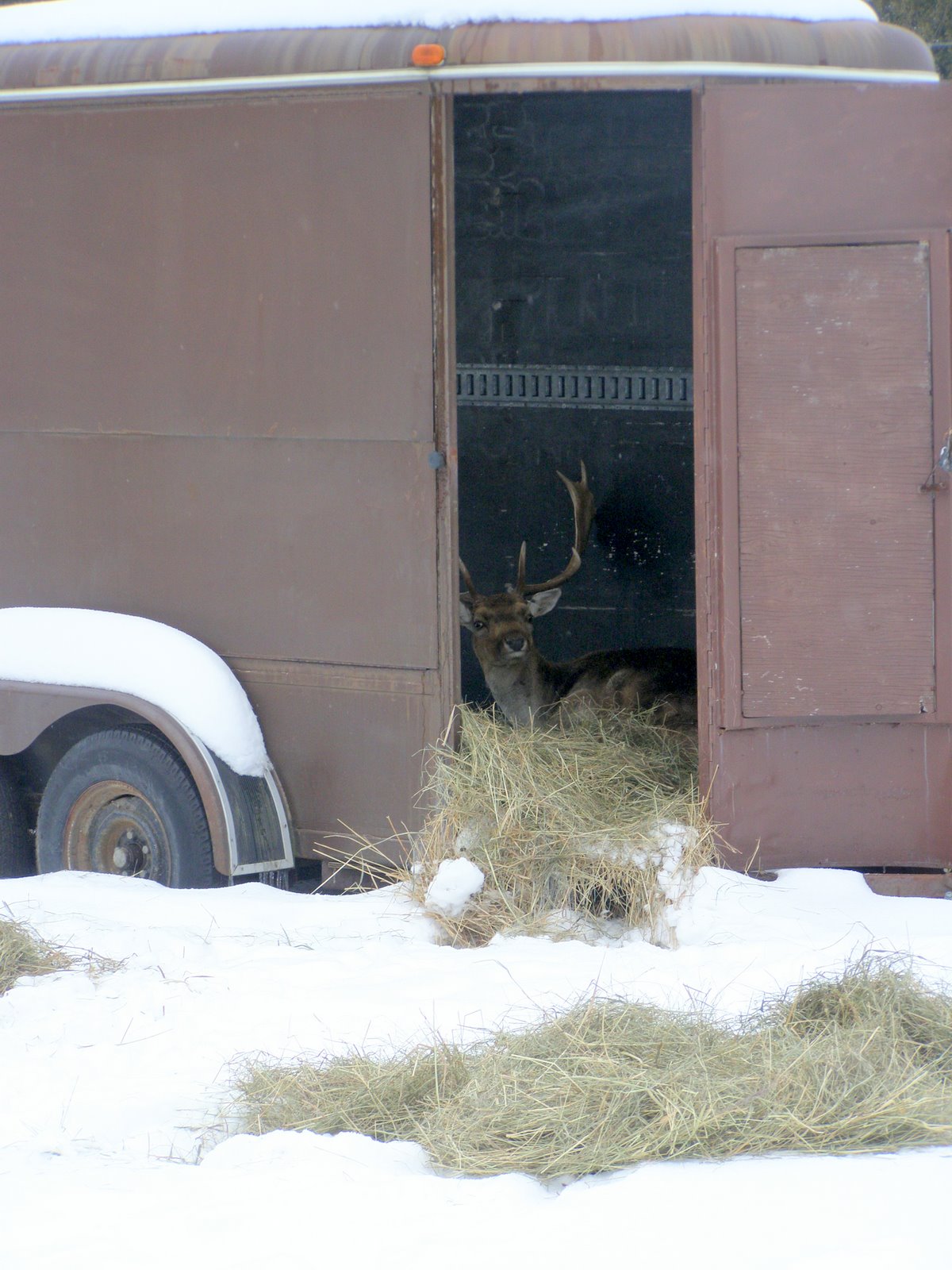
Here's a photo of EGee tucked into the horse trailer in the isolation paddock. He'll be here for 5 days as we have to give him Novo-Trimel twice daily. He is responding well to the meds and the symptoms of lethargy and raspy breathing (pneumonia) are diminishing. He seems to be enjoying his special status!
Thursday, January 13, 2011
Osprey Platform


Thursday, January 06, 2011

Tuesday, December 21, 2010

Tuesday, December 07, 2010
Exploring the new enclosure


Here's what happened when we opened the gates on Sunday, December 5, 2010 and let the bucks explore the new space (about an acre)...new grass and, of course, trees and bushes on which to thrash. Moki and Mike made mincemeat of a small cedar bush in the photo above. No one had problems entering into the new "playground" through the sliding gate designed by Don Murphy. Present to watch the show were Don, Allan Park, Jane McDonald and Wendy Workman who took the photos seen above.
Wednesday, November 03, 2010
Rut 101

Thursday, October 28, 2010
Feeding question
We get asked for our advice and are always happy to try to answer any questions that we can. Please feel free to add your suggestions in the comments and we will be sure to pass them on.
Here is a recent exchange with DM:
Here is a recent exchange with DM:
My Mom has 2 beloved fallow girls....Angel and Peanut. We live in Oregon and do not know of any deer vets, so our equine/goat/large animal vet trys to help as much as they can. We just moved the girls to a 2 acre area across from the other property about 3 weeks ago. They have a very nice stall area to walk in and out as they please and a Great Pyrenees that has always lived with them. The last few days Angel has refused all food and seems a little fearful...usually, as tame and loving as a dog. My Mom spends and enormous amount of time with them and I just pray she doesnt lose one as we have already lost my Dad (her husband) and my Grandmother (her Mother) already this year. Our vet doesnt want to tranquilize her since she said they are so very sensitive to this. They are fed quality grass hay which they have available at all times, purina deer chow (antler max) which they dont seem to like very much and for treats my Mom feeds them nutrigrain bars, whole wheat bread, strawberries, peanuts, grapes and romaine lettuce. I have told her NOT to feed them bread anymore but, cannot think of anything else it might be. I would so much appreciate if you have any information or ideas at all for me to give her. We are having the vet come tomorrow and we are just going to hold her while they check her vitals. I would love to bring my Mom to your reserve to visit one day....she would be in Heaven seeing all the Fallows.
Our deer are all male so we don’t have a huge expertise with females but we have a few thought/possibilities and more questions:
- The doe could be still adjusting to the move and change in her environment. If she started to limp or had poor muscle coordination, we would worry about delayed capture myopathy in an extreme case. However, since the girls are so well socialized, it might be unlikely. How were they moved? Was there any trauma involved in the move? We have heard that Vitamin E helps with stress levels in a deer, so perhaps that might help. Keep in mind body weight. Perhaps the vet could recommend the dosage.
- Possibly the nutrigrain bars might be causing some fermentation or bloating in the stomach, too much refined sugars that affect stomach acids. You mention she is not eating, but is she drinking? Sometimes feeding the girls less is the kindest way to go, so maybe she is on a self-imposed fast to clean out her system. We worry about too much sugar and tooth decay as well. We don’t used any pre-mixed deer feed either. Why do does need antler max? This is designed for hunters who want to fatten up a deer before killing it, and the manufacturers are not concerned with the long-term effects on the animal’s digestive system.
- Any sign of problems in the mouth? Drooling, swelling around the jaw? We lost one deer this way as the infection caused by a tooth abscess went into his jaw. The vet could prescribe some anti-biotics. Will Angel take a piece of apple from your mum’s hand if offered? This is a good way to get the medication into her system.
- It is “rut” season for males (Sept-Oct) and possibly she is experiencing some form of heat. The hormonal changes may be affecting her eating as it does in males. Our guys don’t eat much for a month or more when it’s mating season. Is Angel losing weight? How is she behaving other than not eating?
- Is the feeding area very different in the new place? Could one girl be bullying the other for food? Remember they are herd animals and as the girls age they may show more dominant/submissive behaviours.
We hope this is helpful and if you ever come east, please visit.
Monday, October 25, 2010
2011 Calendars coming soon

Just sent the master of the 2011 desktop calendars to the printer and they should be available in about 20 days. This year's photos are captioned with the name of the deer shown. The cost will be $20 plus postage of $2 per calendar. Ten dollars of the cost can be receipted as a donation to the Fallow Deer Reserve.
This is a limited edition, so if you want to reserve calendar(s), please email your intention to jmcd@reztel.net
Sunday, October 03, 2010
New Fencing

We will be using the space as an isolation paddock for any deer that becomes ill or needs individual attention from us or the vet.

Tuesday, August 31, 2010
Another loss

At about 2pm yesterday afternoon we discovered Gulliver lying in a cedar grove away from the others. At first it looked as if he had injured his front leg and Allan went into the enclosure to see if he could get him to stand up. When he did, we saw that he had been gored in the lower abdomen and a grapefruit-sized portion of his bowels was hanging outside his body. In the shadows we did not see much blood and shortly after standing up, he lay down again with the wound hidden by the earth.
During the past week, the deer were losing their velvet and each one's newest set of "hard" antlers emerged. On Sunday we had observed Max and Bash and then Max and Moki fighting and heard the sound of hard antler on hard antler. We knew that Gulliver was not a fighter, but possibly had been caught by the sharp brow antler of others who are. We will never know just how he came to receive such a serious injury.
We called the vet, Dr. Brian Willows, who asked us to describe the colour and size of the material. He told us that any efforts we would make to try to save his life would be heroics for us, but not for him. There was no doubt that infection from such an injury would occur and cause a slow and painful death even if field surgery were attempted.
We called Don Murphy at work and talked it over with him. He also talked to the vet. We all decided that Gulliver deserved a quick and painless death, and that meant asking someone to put him out of his misery with a bullet. I called upon my neighbour, Bob Bird, who did not hesitate to offer his help.
Allan took Bob to the place where Gulliver lay. I stayed under the maple tree where we have spent so many hours with the herd and they with us. Several of the deer were lying on the ground near me in the shade. At 3:30pm I heard one loud retort. The deer jumped and ran into the woods as far away from the gunshot as they could go.
Gulliver was shot in the cedar grove with a single bullet to his head. He was looking at Allan who thinks that he did not see Bob nor his gun.
Don arrived and we shared some moments with Gulliver's beautiful body. One of our largest and oldest deer, he was the one who escaped from the Scotland Road farm during testing and had been on the lam for about 6 weeks. Don and Wendy spent hours trying to lure him back to the farm and finally accomplished the feat with apples, corn and headlights. After the fence at the Reserve was cut in November 2008, Gulliver was one of the deer who followed Don into the enclosure, returning to this home by his own free will, without need of dramatic capture.
With Don's help we took Gulliver's body to the deer burial ground. With the backhoe, Don dug a deep place. By sunset, Gulliver was lying safely in the earth beside Ty and Dandy.
We are grateful to Bob Bird of Wilton for coming to assist Gulliver at a moment's notice and for his skill and kindness.
Subscribe to:
Posts (Atom)